
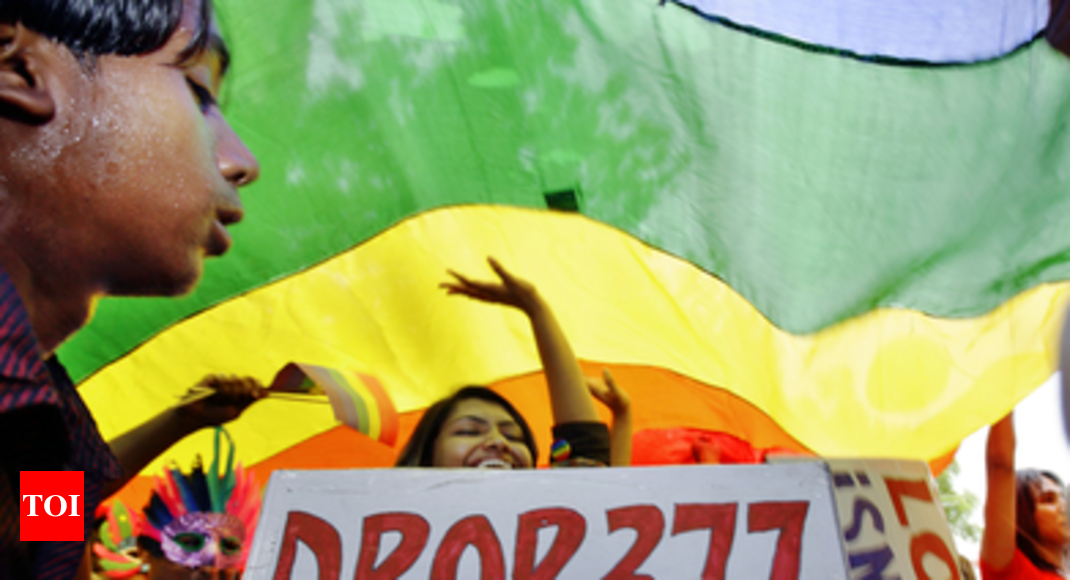
The judgement, by a Constitution bench of the country's top court, has defanged the British-era Section 377 of the Indian Penal Code (IPC), which criminalised sex which deems that gay sex is a punishable offence. The five-judge bench was unanimous in its decision.
Thursday's judgement heralds a new dawn for personal liberty and is a major victory for the LGBTQ (lesbian, gay, bisexual, transgender) community that has been fighting hard and persistently to legalise gay sex.
There were indications that the SC favoured legalising gay sex. All through the hearing of the plea, the apex court had been dropping loud hints that indicated relief from the rigour of Section 377 for consensual adult gay sex. Still, it was the same court that in 2017 overturned a Delhi high court that decriminalised gay sex, so it was by no means a give which way the court would go Thursday.
The top court's verdict was previously set to be delivered on July 17, but on that day, it decided to reserve its verdict. But even as it did that, a bench of Chief Justice Dipak Misra and Justices R F Nariman, A M Khanwilkar, D Y Chandrachud and Indu Malhotra brushed aside as "far-fetched" arguments from opponents of decriminalising Section 377. These opponents said making gay sex legal could lead to incest, group sex and sodomy also being made legal.
Prior to reserving the verdict, the bench had, in what was yet another indication of which way it could go, also disapproved arguments that a majority of the population in India is against legalising gay sex.
"We decide questions of law on the basis of the Constitution, constitutional principles and its ethos and not based on a referendum," said the SC's Constitution bench at the time.
The SC was firm that no community, however small it may be by comparison to the majority, could be deprived of their sexual rights and expression of sexual orientation. While the top court acknowledged that sex as per the order of nature was seen as intercourse between a man and a woman for the purpose of procreation, the fact that it had already recognised a third gender needs to be kept in mind.
"It could have come from the Bible or any other religious text. But the SC has already recognised unique sexual orientation when it created 'third gender' apart from 'male' and 'female' conventionally used till date," it had said.
The five-judge bench was also disinclined to entertain concerted requests from various organisations to leave the decision on decriminalising Section 377 to Parliament given the wide ramification of legalisation of gay sex on matrimonial and civil laws.
"The moment there is a finding that a provision violates the fundamental right of citizens, this court has power to strike it down irrespective of the majoritarian government's power to repeal, amend or enact law. It is for us to strike it down the moment something violates fundamental rights," said back in July.
Two years ago, a petition was filed by dancer N S Johar, journalist Sunil Mehra, chef Ritu Dalmia, hotelier Aman Nath and business executive Ayesha Kapur who said that Section 377 violated their right to privacy and personal liberty.
But even while their petitions were pending, a nine-judge bench of the SC ruled in August 2017 that every individual has a fundamental right to privacy, which is a part of the right to life. That opened the door for fresh pleas to decriminalise gay sex, the argument being that it as a private act.
The issue of Section 377 was first raised by an NGO, Naaz Foundation, which in 2001 approached the Delhi high court that then decriminalised sex between consenting adults of the same gender by holding the penal provision "illegal".
This 2009 judgement of the high court was overturned in 2013 by the SC which restored the criminality of a consensual sexual relationship between persons of the same sex.
from Times of India https://ift.tt/2NkpXLy
